

Diffraction Changes#
Powder Diffraction#
New features#
(#40659) The PDFFourierTransform v2 algorithm has a new minimum range limit,
RminforDirection="Forward"andQminforDirection="Backward".(#40042) HFIR MIDAS instrument definition has been added.
(#40035) AlignAndFocusPowderSlim now outputs multiple workspaces, one for each target, when using the
SplitterWorkspaceproperty. TheSplitterTargetproperty has been removed.(#40095) The
PawleyPattern1Dclass now supports Pawley refinement of TOF workspaces and has new TOF peak profile classBackToBackGaussfor a back-to-back exponential convoluted with a Gaussian.(#40095) The
PawleyPattern1Dclass now supports zero shift and scale factor for reflection d-spacings (equivalent to modifying TZERO and DIFC).(#40478) StitchByBackground v1 has been added, which allows for multiple workspaces with different bin widths to be stitched together.
(#40571) AlignAndFocusPowderSlim can now accept a
mantid.dataobjects.GroupingWorkspace(via theGroupingWorkspaceproperty) to define which detectors go to which output spectra.(#40643) AlignAndFocusPowderSlim is no longer hard-coded for the VULCAN instrument.
Bugfixes#
(#40201) SNSPowderReduction no longer crashes due to the definition of non-standard sample and container geometries.
(#40639) polaris.create_total_scattering_pdf has a new option force_high_q_to_1 to work around a normalisation bug.
Engineering Diffraction#
New features#
(#40668) The Engineering Diffraction interface can now perform Vanadium normalisation during calibration.
(#39922) The Engineering Diffraction interface has two new tabs,
Absorption CorrectionandTexture.The new
Absorption Correctiontab corrects workspaces for the beam attenuation through the sample.The new
Texturetab combines data from focused workspaces and peak fitting and plots pole figures for experimental data.Basic usage of these tabs as part of a texture analysis reduction pipeline has been documented in the texture technique documentation.
(#39931) The automated peak fitting routine
Engineering.texture.TextureUtils.fit_all_peakshas been updated to improve robustness, particularly in terms of fitting peak positions.(#40326) CreatePoleFigureTableWorkspace v1 has two new input properties.
SpectraWorkspaceis the name for a new output workspace which contains spectra corresponding to rows in the standardOutputWorkspacetable.IncludeSpectrumInfois a flag which adds information columns to the finalOutputWorkspaceabout where each spectra has come from.(#40326) The
Engineering.texture.texture_helpermodule has been created to hold stand alone texture functionality which is independent of specific instrument workflows or workflow classes:show_texture_sample_shapeshows the sample present on a workspace along with the texture sample directions, and optionally a gauge volume.load_all_orientationstakes a sequence of workspaces and apply sample orientations, loaded from an input file (as described in the orientation file section of the Texture Analysis Concept doc).create_pole_figure_tablescreates a single pole figure table for a sequence of workspaces and their fit parameters.plot_pole_figurecreates a pole figure plot for a pole figure table.Pole figure plots created by
create_pole_figure_tablesandplot_pole_figurehave flags to add interactive annotation of points in the pole figure (include_spec_infoanddisplay_debug_inforespectively). You can also access this information bt holding the “a” key on the keyboard clicking.
(#40891) The peak fitting routine
Engineering.texture.TextureUtils.fit_all_peaksnow outputs a column for each parameter giving the ratio of value to error.(#40441) EnggEstimateFocussedBackground v1 now uses multi-threading to speed up execution time by factor ~2-3.
(#40599) Added calibrated IDF for POLDI (PSI) post upgrade in December 2025.
(#40599) New loader
load_poldi_h5ffor h5f file produced by POLDI post instrument upgrade available inplugins.algorithms.poldi_utils.(#40599) New features in PoldiAutoCorrelation v6:
Added parameter
NGroupsto split POLDI detectors into groups and produce an autocorrelation spectrum per grouping.
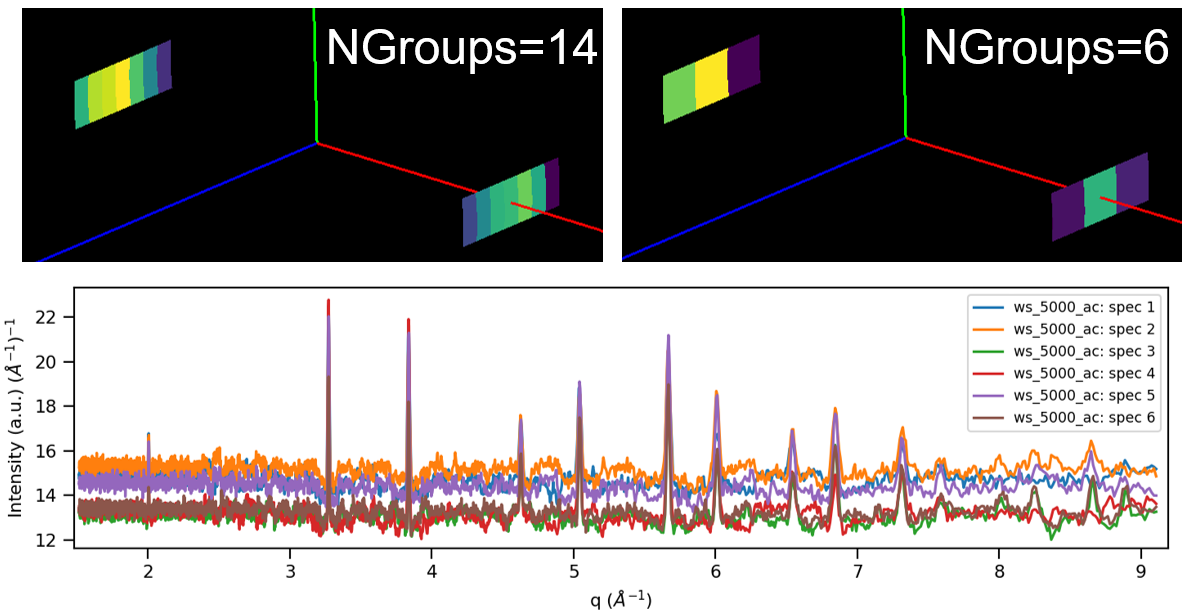
Detector IDs are now associated with autocorrelation spectra in the output workspace.
(#40599) New features in the
PawleyPattern1Dclass fromEngineering.pawley_utils:fit_no_constraintsmethod to perform ‘free’ fit - i.e. do not constrain peak centres to predicted positions.Improvements to the robustness of background estimation.
fit_backgroundmethod to fit background function to 1D data using a cost function that is biased to be less sensitive to positive outliers.
(#40599) Added
PawleyPattern2DNoConstraintsclass inEngineering.pawley_utilsto do a ‘free’ 2D refinement of POLDI data
Bugfixes#
(#40367) Updated the
Focustab processing in the Engineering Diffraction interface to remove zeros outside the data limits.(#40833) A bug in create_total_scattering_pdf where loading non-consecutive runs was causing an error has been fixed.
(#40905) When making use of the TextureCorrectionModel, the divergence correction calculation now scales the errors as well as the intensities.
Single Crystal Diffraction#
New features#
Bugfixes#
(#40291) ConvertQtoHKLMDHisto v1 is now faster by removing an unnecessary copy.
(#40422) Verified and corrected the IMAGINE-X detector layout using neutron absorbing masks.